Wednesday, December 29, 2010

Dehaier Medical Systems Limited : A Shining Star in Medical Device Market

Since I published an article on China Kanghui Holdings (KH) a few months ago, KH has outperformed market by double digits. It had soared from $12 to $23 and is trading around $18 now, 50% higher than my initial recommendation. In a world where many investors are fleeing from hot Chinese IPOs with high valuation matrix, I looked at Chinese small cap stocks and found another well undervalued gem: Dehaier Medical Systems Limited (DHRM).
DHRM is a leading distributor and self-branded provider of medical devices based in Beijing, China. DHRM designs, develops, and markets self-branded homecare medical products (oxygen homecare products) and distributes products manufactured by other companies.
The Chinese government is well aware that the current health care facilities infrastructure and investments made are highly inadequate to cope with the growing needs of the population. Hence, in 2009 the central government decided to disburse an estimated RMB 850 billion (USD 124 billion) over the next three years. This included an estimated RMB 4.1 billion (USD 620 million) to be disbursed for the setting up of CHC (Community Health Centers) and for the purchase of medical devices. A recent report published by the Wharton School of Business, University of Pennsylvania suggests that the expected value of China’s medical device market will reach $28 billion by 2014, representing a 15% CAGR. Because of increasing availability of health care insurance, increasing percentage of GDP to be spent on health care by the government, and growing desire for better quality of care, the medical device market is projected to grow much faster than the global medical device market. Within the next five to seven years, China is expected to surpass Japan and become the second largest medical device market in the world.
With such strong government emphasis and massive investments committed, DHRM has become one of the fastest-growing medical device companies in China today. The company has managed to maintain revenue growth of 35% annually for the past three years and has controlled expenses well. In fact, the profit margin for monitoring devices, one of the key products offered by DHRM, increased from 31.1% in 1H 2009 to 52.1% in 1H 2010 due to effective cost control.
In China, hospitals and clinics purchase almost all of their medical devices and supplies  through distributors. As a result, medical device companies need to develop relationships with several distributors in different regions. DHRM has contractual relationships with over 2000 independent distributors and business relationships with over 3000 hospitals throughout China. Very recently, DHRM had won a $2 million medical device distribution bid for a new rural healthcare construction project supported by the China Development Bank Corp ("CDB"), a major Chinese state-owned bank focused on supporting China's national infrastructure development initiatives. Under the terms of the contract, Dehaier will cooperate with Philips Medical Systems, Olympus Corporation of Japan and many other companies to distribute medical devices to the new healthcare facility. Winning this project gives DHRM entry into the basic-level medical care market and DHRM expects to obtain more projects within this optimal environment. DHRM also established the Customer Experience Center (CEC) network for its Homecare Medical products. The CECs are established to provide broad ranges of branded Homecare Medical products and to meet customer’s expectations, e.g., real time recording system, diversified solutions and treatments etc.
In the recent quarterly report, the company reported a net income of $3.1 million in the first nine months of 2010, up 48% year from the previous year. DHRM also earned $0.77 per share, compared with EPS of $0.69 achieved in the same period a year ago. DHRM is currently traded around $5 at P/E less than five and has the lowest valuation compared to the industry as shown below.


DHRM
Healthcare-Medical
Appliances & Equipment
P/E(TTM)
4.8
19.6
P/B
2.9
2.9
P/S
1.1
2.6
Operating Margin(TTM)
28.30%
20.10%
Net Margin(TTM)
22.90%
10.40%
ROE(TTM)
29.20%
12.30%
Debt/Equity
0.07
0.7

 
DHRM has an extensive marketing network and stable relationships with old customers. It also enhanced its ability to control risk by decreasing dependence on major customers. Because of a strong government support in the medical industry and the direction of healthcare shifting towards community-centric healthcare in China, DHRM’s strong growth trend is expected to continue. In my opinion, DHRM is a well under-valued stock and the current price is definitely a bargain.

Tuesday, December 21, 2010

SkyPeople Fruit Juice: The best beverage stock in the world

SkyPeople Fruit Juice, Inc. (SPU) produces kiwi, apple, pear, jujube and mulberry concentrated fruit juices and fruit juice beverages as well as fresh fruit. It also owns the largest kiwifruit plantation in Asia. As a result, SPU is one of the fastest-growing fruit product companies in China today. The company rode out the financial crisis and has managed to maintain revenue growth of 40% annually for the past four years.
From September to October of 2010, concentrated fruit juice prices have risen from $850 to $1,600 per ton. Due to production cuts in apples from Europe, the price of apple juice in Portland has already increased more than 20%, and the price of apple juice in China is expected to reach $1,800 a ton in the near future.
China consumed 12.5 billion kiloliters of fruit and vegetable juice in 2009, according to Euromonitor International, and this figure is likely to reach 18.1 billion kiloliters within three years. Double-digit growth is therefore likely to remain a feature of the market for some time. In the long run, the future of concentrated fruit juice is very bright due to growing domestic demand. Sales of fruit juice beverages continue to benefit from strong demand from Chinese consumers as more middle-class consumers now drink fruit juices as a healthy alternative to carbonated soft drinks. In the short term, due to expectations of high inflation ahead, rising price will become the catalyst boosting stock prices for fruit juice companies.
First: Two major exporters – China and Portland – are facing inventory reduction and supply shortage problems today. China is currently the world’s largest producer of apple concentrate around the world, with 95% of its annual output exported overseas. FOODNEWS showed that there will be a shortage of concentrated apple juice in China because of rising price.
Second: Orange Juice, once considered to be the substitute of apple juice, also experienced a sharp increase in price. The price of orange juice increased more than 50% in 2009 because of a freezing disaster in the United States, one of the major orange exporters. The price of orange juice has remained above $3,000 per ton due to tight inventories in 2010. As a substitute for orange juice, the rising price of orange juice will definitely increase the demand for apple juice.
SPU is a small-cap company but its strength lies in its diversity. Huiyuan, the largest domestic fruit juice producer, and other peers in China mainly specialize in apple- and orange-related products. SPU, unlike its peers, however, specialized in kiwi juice, which has a much wider profit margin than apple- and orange-related products. Earlier this year, SPU introduced a bottled kiwifruit and mulberry juice under the brand name of Hedetang in Beijing. This helped the company to avoid direct competition with major players like Huiyuan (1886.HK) in China, which mainly produces orange and apple juices. 
In the recent quarterly report, the company reported a net income of $3.6 million, up 71.4% from 3Q 2009, and revenues from kiwifruit and apple concentrates increased 207.6% and 117.6%, respectively, on a yearly basis. Apple and orange concentrated juice   are the most profitable products in SkyPeople’s portfolio. They account for 60% of total revenue in the first 9 months of 2010 and continue to enjoy the rising price in today’s fruit market.
As of September 30th, 2010, the company had US$46.1 million in cash from strong internal cash flows, and its total liability is only $22.3 million. The company’s rich cash position, as well as its strong relationships with local lending institutions, provides SPU adequate funds to support its growth plans.
Because of the strong financial reports and rising demand for its product, SPU recently updated its net income and earnings per share guidance for 2010. The GAAP EPS (diluted) is $0.82 to $0.91, which means the stock is traded at P/E less than 5 today! The price-to-book ratio of SPU is 0.99 with a PEG Ratio of 0.15, which is relatively low and suggests that SPU is a significantly undervalued company with great growth potential.

Considering the huge growth potential of China’s fruit industry, increased fruit beverage consumption and SPU’s strong past performance, SkyPeople Fruit Juice definitely represents a great opportunity for value investors.    

Monday, December 13, 2010

China Ming Yang: Gone with the wind or Fly with the wind?

China Ming Yang Wind Power (MY) announced fantastic results for the past quarter and beat all consensus estimates. However, its share price showed downward momentum and recently traded in the lower 10s. According to Benjamin Graham, the stock’s owners should not be too concerned with erratic fluctuations in stock prices, because the stock market behaves like a voting machine in the short term but acts like a weighing machine in the long term (i.e., the stock’s true value will be reflected in its price over the long run). Instead of viewing MY as an underdog, I believe its current price in the lower 10s provides value investors a very attractive entry value.
 
China’s 12th Five-Year Plan presents an exciting renewable energy plan. It states that the installed capacity of wind power will reach 100 million kW by 2015 and 180 million kW by 2020, which suggests roughly 12 GW of newly installed capacity annually. Ming Yang will benefit from these supportive policies as a leading WTG manufacturing company in China. There are also two key wind power development areas: onshore, including Inner Mongolia and Xinjiang, and offshore, including Jiangsu, Hebei, and so on. Because Ming Yang has also secured wind resources in these key wind power development areas, the long-term relationship with wind farm developers in these areas will definitely boost Ming Yang’s sales in the near future.
In previous articles, I have provided some background on Ming Yang; I will focus on valuation in this article.
 
Valuation
Most financial resources show Ming Yang’s trailing P/E as 18, which makes it look like an overvalued stock. However, it should be pointed out that MY just became profitable in 2010, so its negative earnings in Q4 2009 adversely affected the calculation of its trailing P/E.
In fact, MY has earned US$0.71 in the first nine months of 2010, compared to a net loss of US$0.2 for the same period in 2009.
 
MY’s latest quarterly report shows that the company is aiming to achieve revenue recognition of an estimated 800 1.5 MW WTG units in 2010, and is also targeting an estimated 1400 1.5 MW WTG units and 100 3.0 MW SCD units in 2011.
 
I will show my calculation of estimated revenues for MY in both 2010 and 2011, based on the above information, in the following steps:
1.       Calculation of unit price for 1.5 MW WTG units.
According to the latest quarterly report, the total recognized revenue in the third quarter of 2010 was US$ 222.1 million (RMB 1486.0 million), based on 239 1.5 MW units with an exchange rate of 6.69 RMB/USD. The unit price for 1.5 MW WTG units is $222.1 million ÷ 239 = $0.9293 million/unit.
2.       Calculation of unit price for 3.0 MW SCD units.
On December 7, 2010, MY announced that it had won its bid for a government authorized wind farm project in the Hami area of Xinjiang Uyghur Autonomous Region, China. Ming Yang’s winning bid is equivalent to 67 units of 3.0 MW SCD WTGs with an awarded total contract value of RMB 824 million. Based on an exchange rate of 6.69 RMB/USD, the contract value is $123.2 million and the unit price for 3.0 MW SCD units can be calculated as 123.2 ÷ 67 = $1.8383 million/unit.
3.       Now we can easily estimate that the revenue for MY in 2010 will be 800 x 0.9293 = $743.4 million and (1400 x 0.9293) + (10 x 1.8383) = $1484.9 million in 2011.
 
 
As of September 30, 2010, 4.6 million shares are issued upon the exercise of share options, which were granted to certain directors and employees in Ming Yang. If all of these options were exercised, the net book value per share would decrease to US$ 10.28. Adding back the 125 million common shares, the diluted shares for MY is 125 + 4.6 = 129.6 million.
 
Finally, excluding IPO costs, the net margin per share for MY is 16%. Therefore, we can calculate the net income for MY in 2010 as 743.4*16%/129.6 = $0.92 and 1484.9*16%/129.6 = $1.83 in 2011.
Considering MY’s closing price of 9.9, P/E in 2010 is 11 and forward P/E in 2011 is only 5.5.
 
The order backlog of MY increased to 1,331 units and 363 units (not yet signed) as of September 30, 2010. The cumulative WTGs commissioned in 2010 totals 549 units. The strong demand for MY’s wind turbines and order backlog, together with orders awarded but yet to be signed, makes me feel confident that MY will achieve its revenue target.
 
Goldwind (002202.SZ) is a state-owned pure wind turbine supplier in China and can be seen as MY’s most comparable peer. Goldwind is now trading at 32 trailing P/E and 15 forward P/E.
 
The financial statement for MY is audited by KPMG, one of the “Big 4,” and therefore the credibility of the financial data is ensured. Considering the supportive policies made by the Chinese government and improving profitability from MY, I believe that MY with P/E less than six is obviously an undervalued stock.

Tuesday, November 16, 2010

Top Three Reasons to Buy China MingYang Wind Energy

On November 15th, 2010, China Ming Yang Wind Power (MY) reported its third quarter results for 2010. Shares jumped as much as 14% in early trading after the earnings were released, but the stock pulled back throughout the later trading hours. If there are no material events, I consider MY to be a significantly undervalued stock. In this article, I want to provide my top three reasons to long MY following my previous article.
  1. Strong Financial Highlights
Unit (RMB) 2009-Q12009-Q22009-Q32009-Q42010-Q12010-Q22010-Q3
Revenue149576451989231159339968100807413105361485963
Gross Profit397244322584241722206758249050248654
Diluted (loss) earnings / share-0.32-0.51-0.49-0.91.371.611.7
The above table represents the quarterly results of operations for the quarters in the period from March 31st, 2009 to September 30th, 2010 inclusive. Financial highlights are summarized below:
  • Total revenue increased by 543% over Q3 2009, to RMB 1,486.0 million ($222.1 million).
  • Gross profit increased by 862% over Q3 2009, to RMB 248.7 million ($37.2 million), which is well above the analysts’ estimates of RMB 113-142 million. Gross margin also increased to 16.7% compared to 11.2% for Q3 2009, above analysts’ estimates of 16.5%. The Q3 2010 gross margin is lower than the 19.0% in Q2 2010, due to the sales contract mix in Q3 2010, and should bounce back to over 18% in Q4 2010.
  • Basic and diluted earnings per ordinary share were RMB 1.70 ($0.25) compared with basic and diluted loss per share of RMB 0.49 for the same period in 2009. The most recent analysts’ consensus for FY 2010 is in the range of 0.69 to 0.72. In fact, MY already earned an EPS of $0.69 in the first nine month of 2010 and could easily beat these estimates by several cents.
The quarterly results of operations from MY are affected by seasonal trends. Since customers typically award winning bids for wind farm projects in the first and fourth quarters of each year, the cost of sales in MY is typically higher in the second and third quarters of each year.
It is reasonable to assume MY‘s fourth quarter results will be at least as good as those from the third quarter. This assumption gives an estimate of $0.94 for 2010 EPS. Considering the current closing price of $10.60, P/E in 2010 is only 11, which suggests that MY is significantly undervalued. If we consider that secured sales orders have doubled in the past twelve months and that the sales revenues are not recognized yet, the forward P/E of MY is around 7. MY’s direct competitor, Goldwind, is trading at 15x P/E.
  1. Good “Guanxi” With Chinese Governemnt
“Guanxi” literally means "relationships." In China, the right "Guanxi" makes all the difference in ensuring that a business will be successful. MY has very good “Guanxi” with government and some evidence is shown below:
  • A total of 66 investment projects were reported to the Chinese central government this year, for 5.7 billion RMB, and Ming Yang received 60 million RMB to support its business.Ming Yang received 51 sets of SCD wind turbine orders from the government.
  • In addition, Ming Yang has signed offshore wind farm development agreements with the government of Rudong county, Jiangsu Province, and two new energy subsidiaries of China Huadian Corporation ("Huadian") and China Huaneng Group ("Huaneng") (HNP), two of China's largest wind power developers.
  • On the evening of Oct. 29, 2010, MingYang held a celebration of its successful listing on the NYSE in the United States in Beijing’s Great Hall. This is very rare for a non-state-owned company. Among the companies that were allowed to hold celebrations of listing on a major exchange in Beijing’s Great Hall are the Industrial and Commercial Bank (ICBC), and China Railway, which are state owned enterprises with good “Guanxi” with the government.
  • The newly released 12th Five-Year Plan of China (2011-2015) aims to boost the development of strategic emerging industries, and Beijing will provide 4 trillion RMB ($600 billion) to financially support key emerging industries, including wind, solar, biological, new-energy automobiles, etc.
  1. Coverage From Top Analysts
The joint bookrunners for MY are Morgan Stanley (MS), Merrill Lynch and Credit Suisse (CS). Now the quiet period for IPOs has ended, analysts are beginning to add coverage for this stock. During the last five days, Morgan Stanley started China Mingyang at “Overweight” with a target of $15.40. Merrill Lynch started MY at “Buy” with a target of $17 while Credit Suisse started MY at “Outperform” with a target of $16.10. The current price level offers a huge discount compared to the consensus estimate from analysts and is an optimistic sign for MY.

There are two important attributes that define value investing, according to Michael F. Price, the 271st richest person in the world and a renowned money manager who has earned a reputation for buying undervalued companies. One is patience and the other is focus; this means that one should not be distracted by global or macro forecasts. It is always easier to understand a security than an economy and using this understanding leads the way to profit.

At the current price level, MY is a significantly undervalued stock and offers a price with a discount large enough to allow for a margin of safety. The business of MY is the manufacture and sale of wind turbines and is easily understood. As a technology leader in China’s wind power equipment industry, MY will benefit from the new policies and is well positioned to capture a large share of the fast growing wind energy market in China. With strong sales figures for wind turbine orders and increased demand for wind energy in China, I believe that MY offers a fantastic investment opportunity.

Wednesday, November 3, 2010

Le Gaga: Veggie Lover's favorite

Le Gaga Holdings, Limited (GAGA) is one of the largest greenhouse vegetable producers and one of the fastest growing major vegetable producers in China. Gaga grows vegetables in open fields and greenhouses, and focuses on applying advanced agricultural techniques to grow safe and consistently high-quality vegetables. Over 100 varieties of vegetables are sold to wholesalers, institutional customers and supermarket chains in China and Hong Kong. Their customers include Walmart, the largest grocery retailer in the world, and the top three Hong Kong supermarket chains, Wellcome, ParknShop and Vanguard.
 
As one Chinese proverb suggests, “Hunger breeds discontent.” Agriculture has always been a very important industry in China and contributed 18.1% of China’s GDP in 2009. The largest component of the agricultural industry is farming, contributing 47.7% of the sector’s output, according to Frost & Sullivan. The farming industry in China includes the farming of vegetables, grain, fruit, tea, cotton and other crops.

China is the largest global producer of vegetables by volume. In 2009, China’s vegetable production reached RMB 875.8 billion, and this amount is expected to increase to RMB 1,286.5 billion in 2014. China’s large vegetable production output is due to the availability of arable lands. Vegetables are indispensable ingredients in Chinese cuisine, and China has consistently high vegetable consumption. The idea of a vegetarian diet is stressed by China’s traditional religions, such as Taoism and Buddhism, and welcomed by the Chinese people.
 
Over the past four years, vegetable prices have steadily risen in China and the trends are expected to continue. For example, the wholesale price of cabbage is 10 times more expensive now than it was in 2009.  Since October, 2010, the price of cabbage has gone up nearly 40% within only ten days in Shouguang, Shangdong Province, China’s largest vegetable distributor. Very recently, the KimChi Crisis in South Korea became the catalyst to boost the price of cabbage in China.
 
“In order to obtain a good profit, the key is to develop planting plans," said Mr.  Ma Chengrong, CEO of GAGA, during an interview with financial media: GAGA has developed an effective and comprehensive database to store sales, seed, and vegetable production information in target markets and accumulated valuable proprietary knowledge through years of research and development. A strong brand has been built on the superior quality and safety of GAGA’s produce and the reliability of their supply.
 
The table below shows the operation data for GAGA between 2008 and 2010.
 
2008
2009
2010
Unit
Total arable land area
17103
16525
18850
Mu
Greenhouse Land Area/Total Arable Land area
15.60%
18.90%
23.40%
 
Total production output
57085
69240
98076
Tonnes
Production Yield
3.6
3.9
5.4
Tonnes/Mu
Revenue Per Mu
9611
11167
15497
RMB

As we can see from the above table, the greenhouse land area had grown rapidly to cover 23.4% of total arable land area. The revenue per mu also increased significantly, changing from 9611 RMB to 15497 RMB, representing a CAGR of 17.3%.
 
The latest SEC filing also shows that the company’s revenue had increased 35% year over year to 280 million RMB ($41 million) and profit for the year soared 79% to 110 million RMB ($16.3 million).
 
Agriculture is supported by China’s national policy and the growth of the domestic vegetable market is very large. With the continuous improvement of quality of life of ordinary people, the demand for high-quality brand of vegetables will also increase and offer a fantastic return for the GAGA shareholders.
 
The double benefit of GAGA is of course the stronger Chinese Yuan. The revenues and costs in GAGA are mostly denominated in the Renminbi, and a significant portion of financial assets are also denominated in the Renminbi. According to a note issued by Auriga this week, total scale of Yuan appreciation is estimated to be between 25% and 40% in five years. Those picking U.S.-listed Chinese stocks that are focused on domestic consumption, such as GAGA in the agriculture industry, will be generously rewarded. In the short term, I expect GAGA to reach $13-15 and $20-22 in the next two years.

Wednesday, October 27, 2010

China Ming Yang: A Clean Star with huge growth potentials

China Ming Yang Wind Power Group limited is the largest non-state owned wind turbine manufacturer in China. The Guangdong-based company focuses on designing, manufacturing, selling and servicing wind turbines. It has established customer relationships with leading Chinese state-owned and local power producers.

Wind power technology is cost efficient and mature compared to other renewable energy technologies. According to Global Wind Energy Council, wind power is one of the fastest growing renewable energy technologies in the world.
 
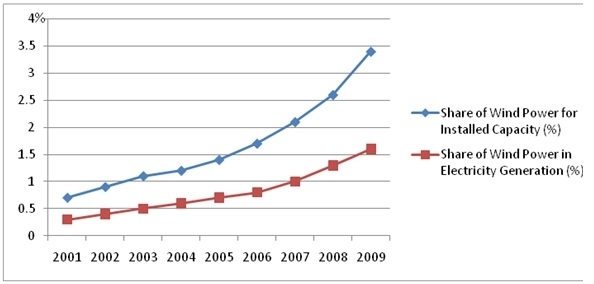
As one Chinese proverb suggests, a picture is worth a thousand words. Let us see one graph as shown below.


The graph sets forth the growth of wind power compared to total global electricity generation according to BTM-Consult Aps –April, 2010.
BTM estimates that global installed cumulative capacity will increase at a CAGR of 22.8% between 2009 and 2014, reaching 447,689MW by the end of 2014.
Wind power development started in China in the late 1980s, but did not begin to grow significantly until 2005. Total installed wind capacity increased from 406MW in 2001 to 25,853MW in 2009, representing a CAGR of 68.1%. China had advanced to the first and second positions in the world in terms of new and cumulative installed capacity by the end of 2009. The most abundant wind resources along coastal areas and offshore are found in Jiangsu, Shandong, Zhejiang, Fujian and Guangdong, where Ming Yang is located.

According to a list compiled by the global accounting firm Ernst & Young in September 2010, China overtook the U.S. to lead a quarterly index of the most attractive countries for renewable energy projects for the first time. China also topped Ernst & Young’s attractiveness index for investments in wind power.

Ming Yang was consistently losing money over the past two years. However, in the past two quarters, the company has made a strong turn around and has generated great earnings. In the meantime, its domestic market share has increased to become among the five largest domestic-branded wind turbine manufacturers in China by the end of 2009, according to BTM. 


In 2008, the company reported its total revenue as $124.7 million. The revenue then increased significantly to $1.17 billion in 2009. In the first half of 2010, Ming Yang continues to grow with the same momentum as the past year. As of June 30, 2010, its total revenue reached $2.31 billion, which doubled the total earnings in 2009. Compared to the first half of 2009, it has increased 285.43%. The management of the company stated the fast growth is mainly due to the sale of the wind turbines. The sales volume significantly increased from 78 sets to 310 sets.

Although the average selling price of wind turbines dropped from RMB 5,365 per watt in the first half of 2009 to RMB 4,098 per watt in the same period of 2010,

The increase in sales of wind turbines successfully offsets the negative impact of price drop.
If we only look at the trailing P/E ratio, MY is definitely expensive.

 
2009
First Half of 2009
First Half of 2010
Basic EPS
-0.33
-0.124
0.44
Diluted EPS
-0.33
-0.124
0.44

 
From comparison of the basic EPS and diluted EPS, the trailing 12-month PE is 44X. This valuation sounds alarming.
Do we stop here? The answer is no and let us take a second look.
Of course, there is something one has to be especially aware of. China Ming Yang was losing money during 2006 to 2009. The company just turned a loss into a gain in the first half of 2010, achieving earnings of $0.44 per share.
According to SEC filings and other Chinese media, Ming Yang’s second half is very positive because of government support, economies of scale, and strong market penetration.
Mr. Chen, vice president of China Ming Yang Wind Power Group, was interviewed by Reuters at the China Alternative Energy Conference this September and indicated that the revenue guidance was at least RMB 10 billion (US$ 1.52 billion). According to the SEC Filings, MY had earned RMB 2.3 billion (US$ 0.34 billion) in revenue during the six months ended June 30, 2010. The revenue in the guidance has tripled the revenues recorded in the first half of 2010 and showed confidence in management.
 
The latest report issued by Industrial Securities indicated that many owners of civil construction projects at the downstream will begin to work in the fourth quarter of any calendar year. Such seasonal factor will make the fourth quarter the best season for the delivery of wind turbines for MY and other wind turbine manufactures.
If we assume that Ming Yang can achieve the same EPS as first half of 2009 in Q3 and Q4, its total 2010 EPS will be 0.88.
Considering today’s closing price of $10.22, its forward PE is around 12X compared to the industrial average of 24X.
For a growth stock like MY, we can also apply the PEG ratio because it explicitly puts a value on the expected growth in company earnings. Compared to its competitors, MY now has a very attractive valuation as shown below.

Company
Ticker
PEG
China Ming Yang Wind Power Group
MY
0.3
A-Power Energy Generation Syste
APWR
0.6
China Wind Systems, Inc.
CWS
0.4
Xinjiang Goldwind Sci & Tech Co., Ltd
002202.SZ
0.7

 
With technological leadership and improved competitiveness through research and development initiatives, China Ming Yang Power Group aims to compete effectively in China’s wind power equipment industry and offers a fantastic investment opportunity.

Thursday, October 21, 2010

Updates on NEWN: Is it too good to be true or too good to pass up?

In my previous article, I provided my analysis on an under-valued stock NEWN (New Energy Systems). In the current article, I want to detail the rationale for investing in this gem.
There is no doubt that Apple changed the world, ever since their creation of the advertising slogan “Think Different” in 1997. Nowadays, we can see people play with iPods, iPhones, and iPads everywhere. Our kids had one Mac computer at home and then the teachers bought several for the computer lab at the schools. The successful launch of iPad and iPhone allowed the company stock to have a major upturn in the past months with a nice 50% return in 2010. Can we benefit from the rally? In the current article, I want to show you why NEWN is a great candidate to benefit from Apple’s rally.
When people are talking about market gurus, Peter Lynch is a name that usually pops up. During his 13 years of service at Fidelity Magellan Fund, the average return was 29% annually and was a record among mutual fund managers. Lynch is a "story" investor. That is, each stock selection is based on a well-grounded expectation concerning the firm’s growth prospects. The expectations are derived from the company’s "story"; what the company is going to do or what is going to happen to bring about the desired results. I will apply this principle to examine NEWN to see whether it qualifies for great investments. 
  1. What is the company going to do?
China has more than 600 million mobile phone subscribers, making it the country with the largest mobile market on the planet. The soaring demand for mobile power sources, such as lithium ion batteries, has fueled New Energy’s organic growth. New Energy’s wholly owned subsidiary, Shenzhen E’Jenie Technology Development Co., Ltd., has been licensed to manufacture backup power systems and accessories interoperable with Apple’s mobile digital devices. These electronic accessories are designed to connect specially to iPod, iPhone, or iPad respectively and have been certified by the developer to meet Apple performance standards.
 The products will be sold under the MeePower™ brand in the international marketplace and are anticipated to be made available to distributors in the U.S. beginning in late 2010.
  1. What it is going to happen?
As China is switching to a domestic, demand-driven economy, the sales of cell phones, laptops, and the like will grow exponentially. It was the first time that the fourth version of the iPhone had been officially available on the Chinese mainland. In September, 2010, the high demand from people in China had caused China Unicom, the country’s sole iPhone distributor, to stop taking online orders. More than 200,000 preorders were received prior to the launch. The pace of sales outstripped those of the previous iPhone 3, which sold 100,000 after six weeks. The rising demand for fancy Apple products will also fuel New Energy’s growth. In a country with $4 billion of lithium ion battery sales per year, a growing, affluent middle class, and an exciting array of innovative mobile devices, such as the iPhone 4, being introduced into the Chinese market, New Energy is well-positioned to grow through its line of quality products, expanding distribution networks, and accretive acquisitions.
  1. How will the company achieve the desired results?
For the second quarter of 2010, the company’s revenue increased 335.2% to approximately $23.4 million, with the adjusted EPS increased 59.1% to $0.35 per diluted share. These amazing results have led the management team in NEWN to reaffirm its revenue guidance of at least $88 million and adjusted net income guidance of at least $15.6 million, or $1.23 per share, for 2010. This is a huge opportunity for NEWN.
NEWN now has a very attractive valuation compared to its peers as shown below.
 

Company
Ticker
P/E
P/B
New Energy Systems Group
NEWN
4.9
1.2
Advanced Battery Tech.
ABAT
8.3
1.8
China BAK Battery
CBAK
N/A
0.8
China Ritar Power Corp
CRTP
7.4
1.4
Hong Kong Highpower
HPJ
8.5
2.1


With strong sales figures for Apple's products and increased demand for its accessories, I believe that NEWN offers a fantastic investment opportunity. My target price for NEWN is $12
– 15 for the short term and $20 – 25 in the next two years.
If you can buy them now at $6, you may be able to bring a next-generation iPad back home with you in 2011, as well as your original investment.